Pain relief innovation in 2026: new combinations, not new molecules.
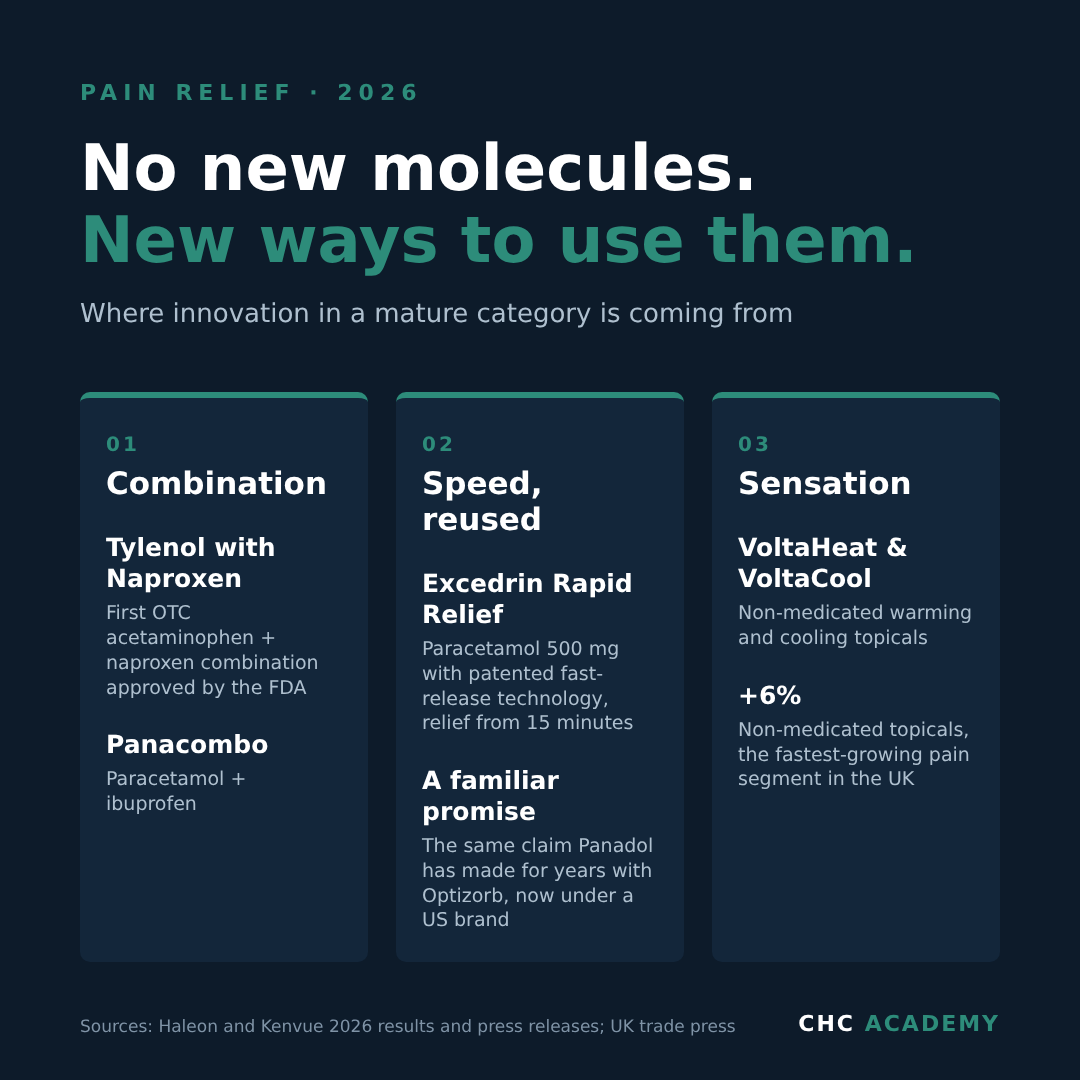
Almost no new molecules reach the pain aisle. What does arrive comes from combinations, from technology moved between brands, from products with no drug at all and, next, from regulators.
The active ingredients in the pain aisle are decades old. Yet 2026 has been busy with launches. Looking at five of them, the pattern is consistent: the molecule stays, and something around it changes. Most efficacy figures below are manufacturer claims, and we say so where they appear.
1. Two old molecules in one tablet
On 24 July 2026 the FDA approved Tylenol with Naproxen from Kenvue, before Kimberly-Clark completed its acquisition of Kenvue on 2 November 2026. Kenvue describes it as the first and only over-the-counter fixed-dose combination of acetaminophen and naproxen sodium in the United States. It is not the first anywhere: in India, RPG Life Sciences already sells Naprosyn P, naproxen 550 mg with paracetamol 500 mg, on prescription. What is new in the US is the combination without a prescription. A dose of 650 mg and 220 mg is two tablets. Kenvue says the approval rests on eight clinical studies showing more pain relief than either ingredient alone, with relief in under 30 minutes and lasting up to 12 hours. The FDA granted three years of exclusivity for the new over-the-counter formulation. Kenvue cites its own March 2026 survey of 6,240 people, in which 75% of persistent pain sufferers said they were dissatisfied with current options.
In the UK, Haleon launched Panacombo, 200 mg of ibuprofen with 500 mg of paracetamol, at a recommended price of £3.50 for ten tablets. Haleon told The Grocer that ibuprofen alone gave effective relief in 37% to 45% of cases and the combination in 67% to 70%. The label restricts it: adults over 18, short term, and only after trying ibuprofen or paracetamol on their own first.
2. Speed technology that travels between brands
Excedrin Rapid Relief is sold in the United States with acetaminophen 500 mg, a patented fast-release technology and the promise that relief starts within 15 minutes. The page carries Haleon's copyright and states that the product is free of caffeine and aspirin. Haleon's professional site for Panadol Optizorb makes the same 15 minute promise for two 500 mg tablets, and describes a technology built on calcium carbonate, alginic acid and crospovidone that breaks the tablet down quickly in the stomach.
The Excedrin page does not name Optizorb, so we cannot say the technology is the same. What is documented is the same company, the same dose and the same promise in two markets. This part is our reading: speed is a claim a company can reuse across brands once it has paid for the evidence.
3. Sensation without a drug
Haleon's VoltaHeat and VoltaCool sit next to Voltaren but contain no pharmaceutical active ingredient. In the UK, Pharmacy Business reported in May 2026 a VoltaHeat warming gel and a warming patch, each at £4.99 at Boots, with wider roll-out from August. The article states that non-medicated topical pain relief is worth more than £70 million, growing 6% and is the fastest-growing part of pain relief. It does not name the source of those figures.
In Germany, apotheke adhoc reported on 2 October 2026 that three products were available at dm for €6.99 each. The gels are cosmetics and the warming plaster is a medical device containing iron. Haleon positions them for minor pain and early symptoms, while the pharmacy only Voltaren medicines stay for moderate to severe pain. A money back trial runs to the end of November, capped at 20,000 redemptions. Haleon describes the drugstore launch as a way to build familiarity, so people later turn to a pharmacy when symptoms get worse.
4. Formats changed for speed, not for experience
The formats in these launches serve onset: fast-dissolving tablets and, in the UK, a Panadol paracetamol liquid capsule described by the British Brands Group as a first for paracetamol. Supplements went the other way. Gummies were the top selling US supplement format in 2025 at 24.6% of sales, according to Nutrition Business Journal figures reported by Nutraceuticals World.
Medicines face a limit that supplements do not. In October 2023 the FDA held a public workshop on defining candy-like nonprescription drug products, because alternatives to conventional tablets are easily confused with candy and have led to misuse and accidental overdose, particularly in young children. This is our reading: part of the gap between pain and supplements is regulatory and safety driven, not a lack of ideas.
5. The next source of newness is the regulator
In the UK, the MHRA published a March 2026 analysis of reclassification, reporting that almost three in four adults (74%) want more medicines available without a prescription. The Department of Health and Social Care had already published a list of conditions where it encourages applications, and pain was identified as a priority category in 2024. The result so far is Naprosyn Pain Relief 250 mg from Maxwellia, authorised in May 2025 as a pharmacy medicine for acute musculoskeletal pain and brought to market in 20 weeks. It is the first over-the-counter pharmacy medicine for that use to contain naproxen.
This is our reading: when the molecules are fixed, a change of legal status is one of the few ways to create a new product, and it creates a new segment inside the pharmacy.
What it means for a brand team
Each of the five routes asks a different question. A combination needs clinical evidence and exclusivity. Reused speed needs a technology and a claim that can travel. A non-drug product needs a clear line between what it promises and what the medicine promises. A new format needs a safety argument. A switch needs a regulator and a pharmacist who agree. Most brand teams have a plan for only one of these.
Questions for your next plan review
- Which two of our active ingredients, taken together, would solve a problem consumers already solve by taking two products?
- Which speed or format technology do we already own that another brand in our portfolio could use?
- Where could a product without a drug open the brand to people who are not yet in the pharmacy?
- Which format would the consumer prefer, and what would a safety review say about it?
- Which of our prescription products could plausibly change legal status, and who would need to agree?
Sources
- Kenvue, FDA approves Tylenol with Naproxen, 24 July 2026; Kenvue Q2 2026 results, Form 8-K.
- Kimberly-Clark, Kimberly-Clark completes acquisition of Kenvue, 2 November 2026.
- Vademecum, Naprosyn P film-coated tablet 550 mg + 500 mg, RPG Life Sciences, India; 1mg, Naprosyn P (prescription required).
- Becker's Hospital Review, FDA approves 1st Tylenol pain relief combination, July 2026.
- The Grocer, Haleon launches Panacombo dual action pain relief tablets; Panacombo summary of product characteristics, medicines.org.uk.
- Excedrin, Excedrin Rapid Relief; Haleon Health Partner, The science behind Optizorb technology.
- Pharmacy Business, Voltarol expands warming products with VoltaHeat, 29 May 2026.
- apotheke adhoc, Haleon bringt Volta zu dm, 2 October 2026.
- British Brands Group, Pain relief innovation with Panadol liquid capsules.
- Nutraceuticals World, supplement delivery formats, 2026, citing Nutrition Business Journal.
- STAT, Candy-like drugs and gummies at the FDA, 30 October 2023; FDA, Defining candy-like nonprescription drug products, 30 October 2023.
- MHRA, How reclassification can transform healthcare, March 2026; P3 Pharmacy, How we achieved our fastest POM to P switch yet; The Daily Brit, Naprosyn Pain Relief launch.